
- page 21
Daher entwickeln sich die Nachkommen der Hybriden, wenn in denselben zweierlei differirende Merkmale verbunden sind, nach dem Ausdrucke:
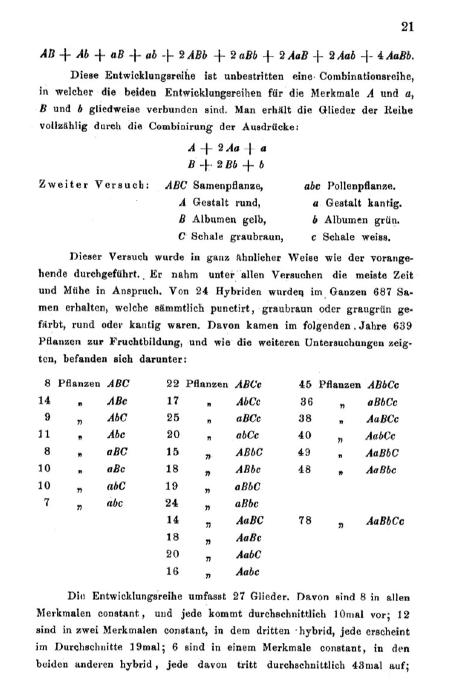
AB + Ab + aB + ab + 2ABb + 2aBb + 2AaB + 2Aab + 4AaBb.
Diese Entwicklungsreihe ist unbestritten eine Combinationsreihe, in welcher die beiden Entwicklungsreihen für die Merkmale A und a, B und b gliedweise verbunden sind. Man erhält die Glieder der Reihe vollzählig durch die Combinirung der Ausdrücke:
A + 2Aa + a
B + 2Bb + b
B + 2Bb + b
| Zweiter Versuch: | ABC | Samenpflanze, | abc | Pollenpflanze. |
| A | Gestalt rund, | a | Gestalt kantig. | |
| B | Albumen gelb, | b | Albumen grün. | |
| C | Schale graubraun, | c | Schale weiss. |
Dieser Versuch wurde in ganz ähnlicher Weise wie der vorangehende durchgeführt. Er nahm unter allen Versuchen die meiste Zeit und Mühe in Anspruch. Von 24 Hybriden wurden im Ganzen 687 Samen erhalten, welche sämmtlich punctirt, graubraun oder graugrün gefärbt, rund oder kantig waren.
Davon kamen im folgenden Jahre 639 Pflanzen zur Fruchtbildung, und wie die weiteren Untersuchungen zeigten, befanden sich darunter:
| 8 | Pflanzen | ABC | 22 | Pflanzen | ABCc | 45 | Pflanzen | ABbCc | ||
| 14 | „ | ABc | 17 | „ | AbCc | 36 | „ | aBbCc | ||
| 9 | „ | AbC | 25 | „ | aBCc | 38 | „ | AaBCc | ||
| 11 | „ | Abc | 20 | „ | abCc | 40 | „ | AabCc | ||
| 8 | „ | aBC | 15 | „ | ABbC | 49 | „ | AaBbC | ||
| 10 | „ | aBc | 18 | „ | ABbc | 48 | „ | AaBbc | ||
| 10 | „ | abC | 19 | „ | aBbC | |||||
| 7 | „ | abc | 24 | „ | aBbc | |||||
| 14 | „ | AaBC | 78 | „ | AaBbCc | |||||
| 18 | „ | AaBc | ||||||||
| 20 | „ | AabC | ||||||||
| 16 | „ | Aabc |
Die Entwicklungsreihe umfasst 27 Glieder.
Davon sind 8 in allen Merkmalen constant, und jede kommt durchschnittlich 10mal vor; 12 sind in zwei Merkmalen constant, in dem dritten hybrid, jede erscheint im Durchschnitte 19mal; 6 sind in einem Merkmale constant, in den beiden anderen hybrid, jede davon tritt durchschnittlich 43mal auf;
eine Form kommt 78mal vor und ist in sämmtlichen Merkmalen hybrid.
The descendants of hybrids, once two kinds of differing traits are joined in them, therefore develop according to the expression:
AB + Ab + aB + ab + 2ABb + 2aBb + 2AaB + 2Aab + 4AaBb.
AB + Ab + aB + ab + 2ABb + 2aBb + 2AaB + 2Aab + 4AaBb.
This developmental series is indisputably a combination series in which both developmental series for the traits A and a, B and b, are joined member by member. One obtains the complete number of members of the series by the combination of the expressions: A + 2Aa + a
B + 2Bb + b
B + 2Bb + b
| Second Trial: | ABC | seed plant, | abc | pollen plant. |
| A | round shape, | a | angular shape. | |
| B | yellow albumen, | b | green albumen. | |
| C | grey-brown coat, | c | white coat. |
This experiment was carried out in a very similar way to the previous one. Among all the experiments, this one asked for the most time and effort. Of 24 hybrids, 687 seeds were obtained in total, all of which were dotted, grey-brown or grey-green in colour, round or angular.
Of these, 639 plants reached fructification in the following year and, as further investigations showed, among them occurred:
| 8 | plants | ABC | 22 | plants | ABCc | 45 | plants | ABbCc | ||
| 14 | „ | ABc | 17 | „ | AbCc | 36 | „ | aBbCc | ||
| 9 | „ | AbC | 25 | „ | aBCc | 38 | „ | AaBCc | ||
| 11 | „ | Abc | 20 | „ | abCc | 40 | „ | AabCc | ||
| 8 | „ | aBC | 15 | „ | ABbC | 49 | „ | AaBbC | ||
| 10 | „ | aBc | 18 | „ | ABbc | 48 | „ | AaBbc | ||
| 10 | „ | abC | 19 | „ | aBbC | |||||
| 7 | „ | abc | 24 | „ | aBbc | |||||
| 14 | „ | AaBC | 78 | „ | AaBbCc | |||||
| 18 | „ | AaBc | ||||||||
| 20 | „ | AabC | ||||||||
| 16 | „ | Aabc |
The developmental series contains 27 members. Of these, 8 are constant in all traits and each occurs on average 10 times; 12 are constant in 2 traits and hybrid in the third, each appears on average 19 times; 6 are constant in one trait, and hybrid in the two others, each of these appears on average 43 times; one form occurs 78 times and is hybrid in all traits.
- page 21