
- page 20
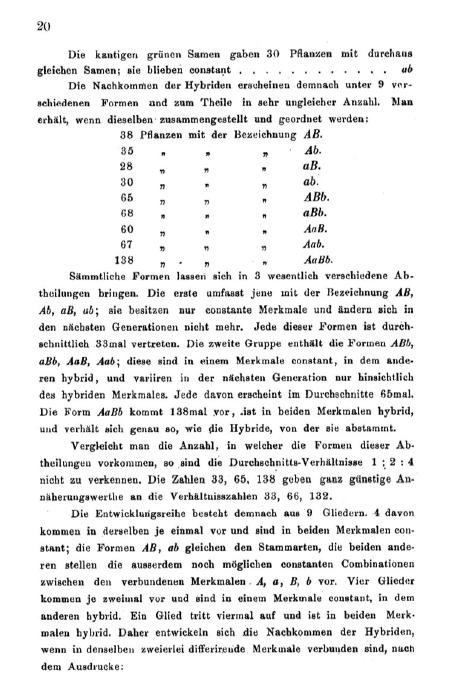
- Die kantigen grünen Samen gaben 30 Pflanzen mit durchaus gleichen Samen; sie blieben constant ab
| 38 | Pflanzen | mit der | Bezeichnung | AB. |
| 35 | „ | „ | „ | Ab. |
| 28 | „ | „ | „ | aB. |
| 30 | „ | „ | „ | ab. |
| 65 | „ | „ | „ | ABb. |
| 68 | „ | „ | „ | aBb. |
| 60 | „ | „ | „ | AaB. |
| 67 | „ | „ | „ | Aab. |
| 138 | „ | „ | „ | AaBb. |
Sämmtliche Formen lassen sich in 3 wesentlich verschiedene Abtheilungen bringen. Die erste umfasst jene mit der Bezeichnung AB, Ab, aB, ab; sie besitzen nur constante Merkmale und ändern sich in den nächsten Generationen nicht mehr. Jede dieser Formen ist durchschnittlich 33mal vertreten. Die zweite Gruppe enthält die Formen ABb, aBb, AaB, Aab; diese sind in einem Merkmale constant, in dem anderen hybrid, und variiren in der nächsten Generation nur hinsichtlich des hybriden Merkmales. Jede davon erscheint im Durchschnitte 65mal. Die Form AaBb kommt 138mal vor, ist in beiden Merkmalen hybrid, und verhält sich genau so, wie die Hybride, von der sie abstammt.
Vergleicht man die Anzahl, in welcher die Formen dieser Abtheilungen vorkommen, so sind die Durchschnitts-Verhältnisse 1 : 2 : 4 nicht zu verkennen. Die Zahlen 33, 65, 138 geben ganz günstige Annäherungswerthe an die Verhältnisszahlen 33, 66, 132.
Die Entwicklungsreihe besteht demnach aus 9 Gliedern. 4 davon kommen in derselben je einmal vor und sind in beiden Merkmalen constant; die Formen AB, ab gleichen den Stammarten, die beiden anderen stellen die ausserdem noch möglichen constanten Combinationen zwischen den verbundenen Merkmalen A, a, B, b vor. Vier Glieder kommen je zweimal vor und sind in einem Merkmale constant, in dem anderen hybrid. Ein Glied tritt viermal auf und ist in beiden Merkmalen hybrid.
Daher entwickeln sich die Nachkommen der Hybriden, wenn in denselben zweierlei differirende Merkmale verbunden sind, nach dem Ausdrucke:
AB + Ab + aB + ab + 2ABb + 2aBb + 2AaB + 2Aab + 4AaBb.
- The angular green seeds yielded 30 plants which bore seeds all of like character; they remained constant ab
| 38 | plants | with the | designation | AB. |
| 35 | „ | „ | „ | Ab. |
| 28 | „ | „ | „ | aB. |
| 30 | „ | „ | „ | ab. |
| 65 | „ | „ | „ | ABb. |
| 68 | „ | „ | „ | aBb. |
| 60 | „ | „ | „ | AaB. |
| 67 | „ | „ | „ | Aab. |
| 138 | „ | „ | „ | AaBb. |
All of the forms can be brought under three essentially different divisions. The first of these contains those with the designation AB, Ab, aB, ab; they possess only constant traits and do not change any more in the next generations. Each of these forms is represented on average 33 times. The second group contains the forms ABb, aBb, AaB, Aab; these are constant with respect to one trait, hybrid with respect to the other, and vary in the next generation with respect to the hybrid trait only. Each of these appears on average 65 times. The form AaBb occurs 138 times, is hybrid in both traits and behaves exactly like the hybrid from which it descends.
If one compares the quantity in which these forms occur under their divisions, then the average proportions of 1 : 2 : 4 cannot be missed. The numbers 33, 65, 138 give quite favourable approximate values to the numerical proportions of 33, 66, 132.
The developmental series thus consists of 9 members. Four of these appear once each in the series and are constant in both traits; the forms AB, ab resemble the parent-species, the other two represent the constant combinations between the conjoined traits A, a, B, b that are possible in addition. Four members appear twice each and are constant in one trait and hybrid in the other. One member occurs four times and is hybrid in both traits. The descendants of hybrids, once two kinds of differing traits are joined in them, therefore develop according to the expression:
AB + Ab + aB + ab + 2ABb + 2aBb + 2AaB + 2Aab + 4AaBb.
AB + Ab + aB + ab + 2ABb + 2aBb + 2AaB + 2Aab + 4AaBb.
- page 20