
- page 46
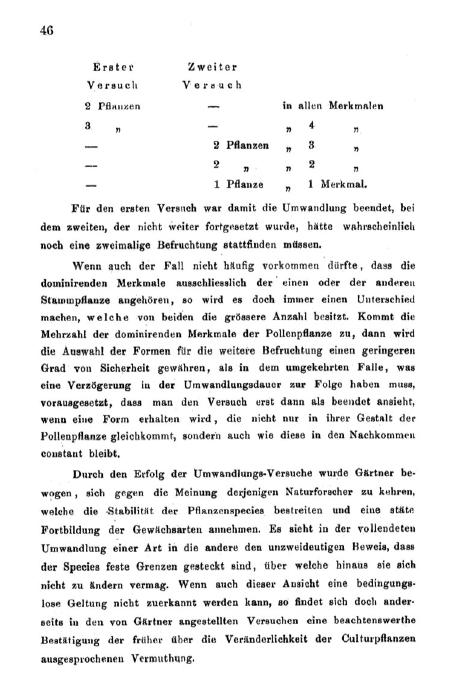
Unter je 5 Pflanzen, welche für die beiden Versuche zur Befruchtung verwendet waren, stimmten, wie der nächstjährige Anbau zeigte, mit der Pollenpflanze überein:
| Erster | Zweiter | |||||
| Versuch | Versuch | |||||
| 2 | Pflanzen | — | in | allen | Merkmalen | |
| 3 | „ | — | „ | 4 | „ | |
| — | 2 | Pflanzen | „ | 3 | „ | |
| — | 2 | „ | „ | 2 | „ | |
| — | 1 | Pflanze | „ | 1 | Merkmal. | |
Wenn auch der Fall nicht häufig vorkommen dürfte, dass die dominirenden Merkmale ausschliesslich der einen oder der anderen Stammpflanze angehören, so wird es doch immer einen Unterschied machen, welche von beiden die grössere Anzahl besitzt. Kommt die Mehrzahl der dominirenden Merkmale der Pollenpflanze zu, dann wird die Auswahl der Formen für die weitere Befruchtung einen geringeren Grad von Sicherheit gewähren, als in dem umgekehrten Falle, was eine Verzögerung in der Umwandlungsdauer zur Folge haben muss, vorausgesetzt, dass man den Versuch erst dann als beendet ansieht, wenn eine Form erhalten wird, die nicht nur in ihrer Gestalt der Pollenpflanze gleichkommt, sondern auch wie diese in den Nachkommen constant bleibt.
Durch den Erfolg der Umwandlungs-Versuche wurde Gärtner bewogen, sich gegen die Meinung derjenigen Naturforscher zu kehren, welche die Stabilität der Pflanzenspecies bestreiten und eine stäte Fortbildung der Gewächsarten annehmen. Er sieht in der vollendeten Umwandlung einer Art in die andere den unzweideutigen Beweis, dass der Species feste Grenzen gesteckt sind, über welche hinaus sie sich nicht zu ändern vermag.
Wenn auch dieser Ansicht eine bedingungslose Geltung nicht zuerkannt werden kann, so findet sich doch anderseits in den von Gärtner angestellten Versuchen eine beachtenswerthe Bestätigung der früher über die Veränderlichkeit der Culturpflanzen ausgesprochenen Vermuthung.
Among five plants each that had been used for fertilisation in the two experiments, the following, as shown by cultivation in the next year, agreed with the pollen plant:
| First | Second | |||||
| Experiment | Experiment | |||||
| 2 | plants | — | in | all | traits | |
| 3 | „ | — | „ | 4 | „ | |
| — | 2 | plants | „ | 3 | „ | |
| — | 2 | „ | „ | 2 | „ | |
| — | 1 | plant | „ | 1 | trait. | |
Even if the case that the dominating traits belong exclusively to one or the other of the parental plants will not occur frequently, it will nevertheless always make a difference which of the two possesses the larger quantity. If the majority of the dominating traits belong to the pollen plant, then the selection of forms for further fertilisation will provide a lower degree of certainty than in the opposite case, which must result in a delay in the duration of transformation, if it is presumed that the experiment is only considered complete once a form is obtained which not only matches the pollen plant in its shape but, like it, also remains constant in its progeny.
Through the success of the transformation experiments, Gärtner was motivated to turn against the opinion of those naturalists who dispute the stability of plant species and assume a continuous progressive development of vegetable species. In the completed transformation of one species into the other, he sees unambiguous proof that fixed limits are set for a species beyond which it cannot change itself. Even if unconditional validity cannot be awarded to this view, one does find in the experiments performed by Gärtner, on the other hand, a remarkable confirmation of the conjecture expressed earlier on the variability of cultivated plants .
- page 46