
- page 18
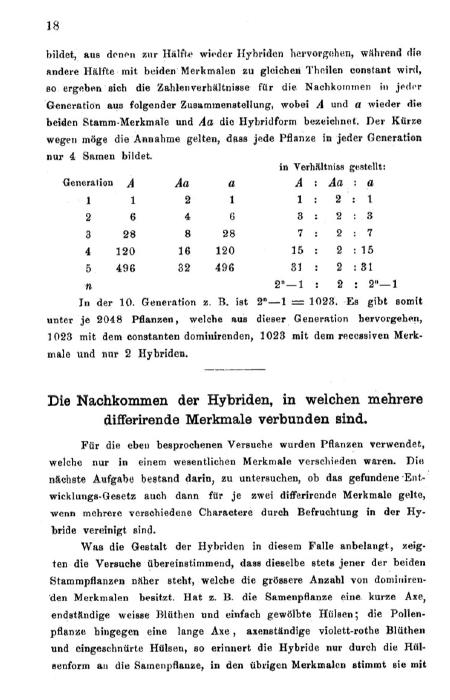
Nimmt man durchschnittlich für alle Pflanzen in allen Generationen eine gleich grosse Fruchtbarkeit an, erwägt man ferner, dass jede Hybride Samen
bildet, aus denen zur Hälfte wieder Hybriden hervorgehen, während die andere Hälfte mit beiden Merkmalen zu gleichen Theilen constant wird, so ergeben sich die Zahlenverhältnisse für die Nachkommen in jeder Generation aus folgender Zusammenstellung, wobei A und a wieder die beiden Stamm-Merkmale und Aa die Hybridform bezeichnet.
Der Kürze wegen möge die Annahme gelten, dass jede Pflanze in jeder Generation nur 4 Samen bildet. | in Verhältniss gestellt: | ||||||||
| Generation | A | Aa | a | A | : | Aa | : | a |
| 1 | 1 | 2 | 1 | 1 | : | 2 | : | 1 |
| 2 | 6 | 4 | 6 | 3 | : | 2 | : | 3 |
| 3 | 28 | 8 | 28 | 7 | : | 2 | : | 7 |
| 4 | 120 | 16 | 120 | 15 | : | 2 | : | 15 |
| 5 | 496 | 32 | 496 | 31 | : | 2 | : | 31 |
| n | 2n -1 | : | 2 | : | 2n -1 | |||
In der 10. Generation z. B. ist 2n -1 = 1023. Es gibt somit unter je 2048 Pflanzen, welche aus dieser Generation hervorgehen, 1023 mit dem constanten dominirenden, 1023 mit dem recessiven Merkmale und nur 2 Hybriden.
8. Die Nachkommen der Hybriden, in welchen mehrere differirende Merkmale verbunden sind.
Für die eben besprochenen Versuche wurden Pflanzen verwendet, welche nur in einem wesentlichen Merkmale verschieden waren. Die nächste Aufgabe bestand darin, zu untersuchen, ob das gefundene Entwicklungs-Gesetz auch dann für je zwei differirende Merkmale gelte, wenn mehrere verschiedene Charactere durch Befruchtung in der Hybride vereinigt sind.
Was die Gestalt der Hybriden in diesem Falle anbelangt, zeigten die Versuche übereinstimmend, dass dieselbe stets jener der beiden Stammpflanzen näher steht, welche die grössere Anzahl von dominirenden Merkmalen besitzt.
Hat z. B. die Samenpflanze eine kurze Axe, endständige weisse Blüthen und einfach gewölbte Hülsen; die Pollenpflanze hingegen eine lange Axe, axenständige violett-rothe Blüthen und eingeschnürte Hülsen, so erinnert die Hybride nur durch die Hülsenform an die Samenpflanze, in den übrigen Merkmalen stimmt sie mit
der Pollenpflanze überein.
If one assumes that all plants in all generations, on average, have an equal degree of fertility, and if one considers furthermore that each hybrid produces seeds, half of which will give rise to hybrids again, while the other half becomes constant in equal parts with both traits, then the numerical proportions for progeny in each generation emerge from the following tabulation, where A and a again denote the two parental traits and Aa the hybrid form. For the sake of brevity the assumption may hold that each plant forms four seeds only in every generation.
| put in proportion: | ||||||||
| Generation | A | Aa | a | A | : | Aa | : | a |
| 1 | 1 | 2 | 1 | 1 | : | 2 | : | 1 |
| 2 | 6 | 4 | 6 | 3 | : | 2 | : | 3 |
| 3 | 28 | 8 | 28 | 7 | : | 2 | : | 7 |
| 4 | 120 | 16 | 120 | 15 | : | 2 | : | 15 |
| 5 | 496 | 32 | 496 | 31 | : | 2 | : | 31 |
| n | 2n -1 | : | 2 | : | 2n -1 | |||
In the tenth generation, for example, 2n -1 = 1023. There thus exist among 2048 plants respectively that originate in this generation, 1023 with the constant dominating trait, 1023 with the recessive trait, and only 2 hybrids.
8. The descendants of hybrids in which several differing traits are joined.
In the experiments just reviewed, plants were used that were different in one essential trait only. The next task consisted in investigating whether the developmental law that was found is also valid for two differing traits respectively in those cases where several different characteristics are united through fertilisation in the hybrid.
Concerning the conformation of hybrids in this case, the experiments showed concordantly that the same always stands closer to that of the two parental plants which possesses the greater quantity of dominating traits. If, for example, the seed plant has a short axis, white flowers positioned distally, and simply arched pods, whereas the pollen plant has a long axis, violet-red flowers positioned axially, and constricted pods, then the hybrid recalls the seed plant only with respect to the form of the pod; in the remaining traits it agrees with the pollen plant.
- page 18