
- page 19
Hat z. B. die Samenpflanze eine kurze Axe, endständige weisse Blüthen und einfach gewölbte Hülsen; die Pollenpflanze hingegen eine lange Axe, axenständige violett-rothe Blüthen und eingeschnürte Hülsen, so erinnert die Hybride nur durch die Hülsenform an die Samenpflanze, in den übrigen Merkmalen stimmt sie mit
der Pollenpflanze überein.
Besitzt eine der beiden Stammarten nur dominirende Merkmale, dann ist die Hybride von derselben kaum oder gar nicht zu unterscheiden. Mit einer grösseren Anzahl Pflanzen wurden zwei Versuche durchgeführt. Bei dem ersten Versuche waren die Stammpflanzen in der Gestalt der Samen und in der Färbung des Albumens verschieden; bei dem zweiten in der Gestalt der Samen, in der Färbung des Albumens und in der Farbe der Samenschale. Versuche mit Samen-Merkmalen führen am einfachsten und sichersten zum Ziele.
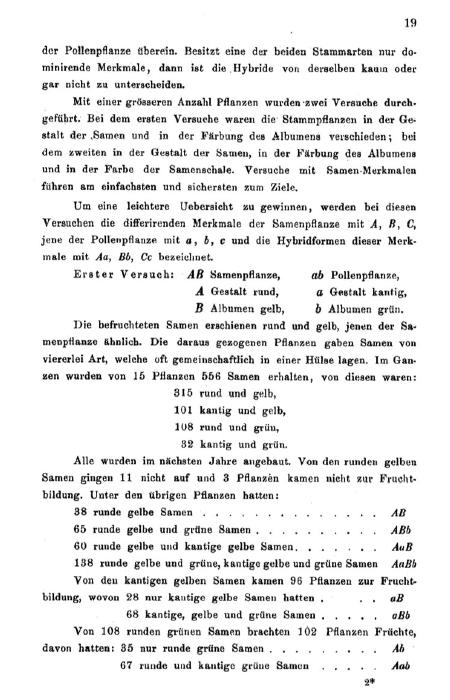
| Erster Versuch: | AB | Samenpflanze, | ab | Pollenpflanze, |
| A | Gestalt rund, | a | Gestalt kantig, | |
| B | Albumen gelb, | b | Albumen grün. |
Die befruchteten Samen erschienen rund und gelb, jenen der Samenpflanze ähnlich. Die daraus gezogenen Pflanzen gaben Samen von viererlei Art, welche oft gemeinschaftlich in einer Hülse lagen. Im Ganzen wurden von 15 Pflanzen 556 Samen erhalten, von diesen waren:
Alle wurden im nächsten Jahre angebaut. Von den runden gelben Samen gingen 11 nicht auf und 3 Pflanzen kamen nicht zur Fruchtbildung. Unter den übrigen Pflanzen hatten:
| 315 | rund und gelb, |
| 101 | kantig und gelb, |
| 108 | rund und grün, |
| 32 | kantig und grün. |
- 38 runde gelbe SamenAB
- 65 runde gelbe und grüne SamenABb
- 60 runde gelbe und kantige gelbe SamenAaB
- 138 runde gelbe und grüne, kantige gelbe und grüne SamenAaBb
If, for example, the seed plant has a short axis, white flowers positioned distally, and simply arched pods, whereas the pollen plant has a long axis, violet-red flowers positioned axially, and constricted pods, then the hybrid recalls the seed plant only with respect to the form of the pod; in the remaining traits it agrees with the pollen plant. If one of the two parent-species only possesses dominating traits, then the hybrid is barely distinguishable from it, or not at all.
Two trials were carried out with a larger number of plants. In the first experiment, the seed plants differed by the shape of the seeds and by the colouration of the albumen; in the second, by the shape of the seeds, the colouration of the albumen and the colour of the seed coat. Experiments with seed traits lead to the goal in the simplest and most reliable manner.
| First trial: | AB | seed plant, | ab | pollen plant, |
| A | round shape, | a | angular shape, | |
| B | yellow albumen, | b | green albumen. |
The fertilized seeds appeared round and yellow, similar to those of the seed plant. The plants raised from these gave seeds of four kinds, which often lay together in one pod. All in all, 556 seeds were obtained from 15 plants; of these there were:
All were cultivated in the next year. Of the round yellow seeds, eleven did not germinate, and three plants did not reach fructification. Among the remaining plants:
| 315 | round and yellow, |
| 101 | angular and yellow, |
| 108 | round and green, |
| 32 | angular and green. |
- 38 had round yellow seedsAB
- 65 had round yellow and green seedsABb
- 60 had round yellow and angular yellow seedsAaB
- 138 had round yellow and green, angular yellow and green seedsAaBb
- page 19