
- page 26
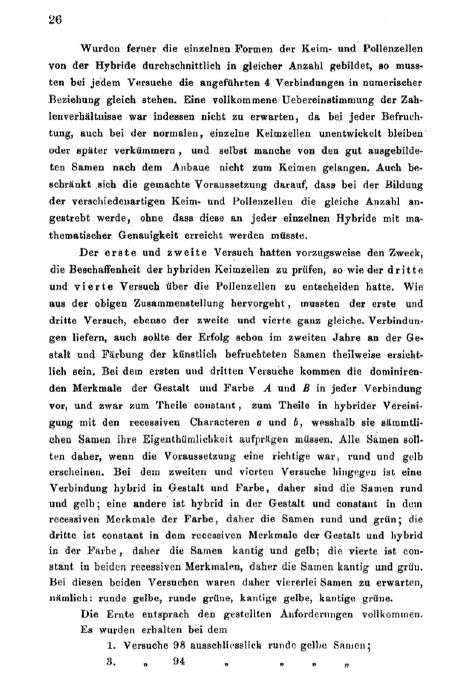
Wurden ferner die einzelnen Formen der Keim- und Pollenzellen von der Hybride durchschnittlich in gleicher Anzahl gebildet, so mussten bei jedem Versuche die angeführten 4 Verbindungen in numerischer Beziehung gleich stehen. Eine vollkommene Uebereinstimmung der Zahlenverhältnisse war indessen nicht zu erwarten, da bei jeder Befruchtung, auch bei der normalen, einzelne Keimzellen unentwickelt bleiben oder später verkümmern, und selbst manche von den gut ausgebildeten Samen nach dem Anbaue nicht zum Keimen gelangen. Auch beschränkt sich die gemachte Voraussetzung darauf, dass bei der Bildung der verschiedenartigen Keim- und Pollenzellen die gleiche Anzahl angestrebt werde, ohne dass diese an jeder einzelnen Hybride mit mathematischer Genauigkeit erreicht werden müsste.
Der erste und zweite Versuch hatten vorzugsweise den Zweck, die Beschaffenheit der hybriden Keimzellen zu prüfen, so wie der dritte und vierte Versuch über die Pollenzellen zu entscheiden hatte. Wie aus der obigen Zusammenstellung hervorgeht, mussten der erste und dritte Versuch, ebenso der zweite und vierte ganz gleiche Verbindungen liefern, auch sollte der Erfolg schon im zweiten Jahre an der Gestalt und Färbung der künstlich befruchteten Samen theilweise ersichtlich sein. Bei dem ersten und dritten Versuche kommen die dominirenden Merkmale der Gestalt und Farbe A und B in jeder Verbindung vor, und zwar zum Theile constant, zum Theile in hybrider Vereinigung mit den recessiven Characteren a und b, wesshalb sie sämmtlichen Samen ihre Eigenthümlichkeit aufprägen müssen. Alle Samen sollten daher, wenn die Voraussetzung eine richtige war, rund und gelb erscheinen. Bei dem zweiten und vierten Versuche hingegen ist eine Verbindung hybrid in Gestalt und Farbe, daher sind die Samen rund und gelb; eine andere ist hybrid in der Gestalt und constant in dem recessiven Merkmale der Farbe, daher die Samen rund und grün; die dritte ist constant in dem recessiven Merkmale der Gestalt und hybrid in der Farbe, daher die Samen kantig und gelb; die vierte ist constant in beiden recessiven Merkmalen, daher die Samen kantig und grün. Bei diesen beiden Versuchen waren daher viererlei Samen zu erwarten, nämlich: runde gelbe, runde grüne, kantige gelbe, kantige grüne.
If, furthermore, the individual forms of germ and pollen cells were formed by the hybrid in equal quantities on average, then in each trial the four conjunctions listed had to equal each other with respect to their number. A perfect agreement of the numerical proportions, however, was not to be expected, since in each fertilisation, including the normal one, certain germ cells remain undeveloped or whither later on, and since even some of the well-developed seeds do not reach germination after cultivation. The presupposition made, moreover, confines itself to the claim that the same quantity is aspired to in the formation of the germ- and pollen cells of various kind, without this having to be attained on each individual hybrid with mathematical exactness.
The first and second trials primarily had the aim of testing the constitution of the hybrid germ cells, just as the third and fourth trials were to decide about the pollen cells. As is evident from the above tabulation, the first and third trials had to render entirely identical conjunctions, just like the second and fourth; the success should also become partially apparent in the shape and colour of the artificially fertilized seeds in the second year already. In the first and third trials, the dominating traits A and B for shape and colour occur in each conjunction, in part constantly, in part in hybrid union with the recessive characteristics a and b, which is why they have to impress their peculiarity on all seeds. All seeds should therefore, if the presupposition was correct, appear round and yellow. In the second and fourth trials, in contrast, one conjunction is hybrid in shape and colour, the seeds therefore being round and yellow; another is hybrid in shape and constant in the recessive trait for colour, the seeds therefore round and green; the third is constant in the recessive trait for shape and hybrid for colour, the seeds therefore angular and yellow; the fourth is constant in both recessive traits, the seeds therefore angular and green. In these two trials, therefore, four kinds of seed were to be expected, namely: round yellow, round green, angular yellow, [and] angular green [ones].
There were obtained in the
| 1st | trial | 98 | exclusively | round | yellow | seeds; |
| 3rd | „ | 94 | „ | „ | „ | „ |
2nd trial 31 round yellow, 26 round green, 27 angular yellow, 26 angular green seeds;
4th trial 24 round yellow, 25 round green, 22 angular yellow and 27 angular green seeds were received.
- page 26