
- page 41
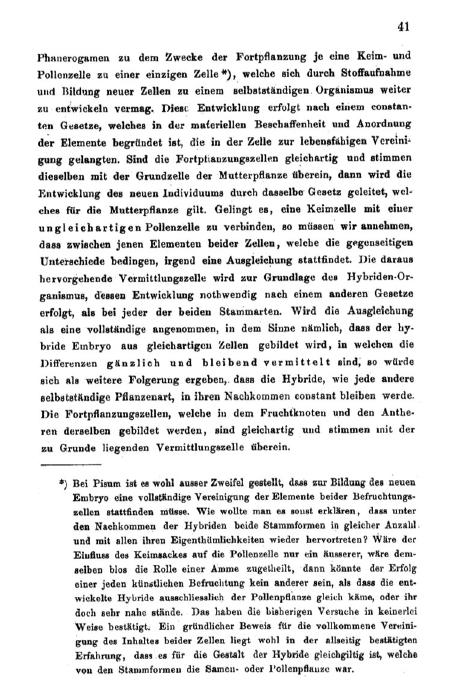
Nach der Ansicht berühmter Physiologen vereinigen sich bei den
Phanerogamen zu dem Zwecke der Fortpflanzung je eine Keim- und Pollenzelle zu einer einzigen Zelle *), welche sich durch Stoffaufnahme und Bildung neuer Zellen zu einem selbstständigen Organismus weiter zu entwickeln vermag.
Diese Entwicklung erfolgt nach einem constanten Gesetze, welches in der materiellen Beschaffenheit und Anordnung der Elemente begründet ist, die in der Zelle zur lebensfähigen Vereinigung gelangten. Sind die Fortpflanzungszellen gleichartig und stimmen dieselben mit der Grundzelle der Mutterpflanze überein, dann wird die Entwicklung des neuen Individuums durch dasselbe Gesetz geleitet, welches für die Mutterpflanze gilt. Gelingt es, eine Keimzelle mit einer ungleichartigen Pollenzelle zu verbinden, so müssen wir annehmen, dass zwischen jenen Elementen beider Zellen, welche die gegenseitigen Unterschiede bedingen, irgend eine Ausgleichung stattfindet. Die daraus hervorgehende Vermittlungszelle wird zur Grundlage des Hybriden-Organismus, dessen Entwicklung nothwendig nach einem anderen Gesetze erfolgt, als bei jeder der beiden Stammarten. Wird die Ausgleichung als eine vollständige angenommen, in dem Sinne nämlich, dass der hybride Embryo aus gleichartigen Zellen gebildet wird, in welchen die Differenzen gänzlich und bleibend vermittelt sind, so würde sich als weitere Folgerung ergeben, dass die Hybride, wie jede andere selbstständige Pflanzenart, in ihren Nachkommen constant bleiben werde. Die Fortpflanzungszellen, welche in dem Fruchtknoten und den Antheren derselben gebildet werden, sind gleichartig und stimmen mit der zu Grunde liegenden Vermittlungszelle überein.
*) Bei Pisum ist es wohl ausser Zweifel gestellt, dass zur Bildung des neuen Embryo eine vollständige Vereinigung der Elemente beider Befruchtungszellen stattfinden müsse. Wie wollte man es sonst erklären, dass unter den Nachkommen der Hybriden beide Stammformen in gleicher Anzahl und mit allen ihren Eigenthümlichkeiten wieder hervortreten? Wäre der Einfluss des Keimsackes auf die Pollenzelle nur ein äusserer, wäre demselben blos die Rolle einer Amme zugetheilt, dann könnte der Erfolg einer jeden künstlichen Befruchtung kein anderer sein, als dass die entwickelte Hybride ausschliesslich der Pollenpflanze gleich käme, oder ihr doch sehr nahe stände. Das haben die bisherigen Versuche in keinerlei Weise bestätigt. Ein gründlicher Beweis für die vollkommene Vereinigung des Inhaltes beider Zellen liegt wohl in der allseitig bestätigten Erfahrung, dass es für die Gestalt der Hybride gleichgiltig ist, welche von den Stammformen die Samen- oder Pollenpflanze war.
According to the opinion of famous physiologists, in phanerogams one germ and one pollen cell respectively unite to form a single cell*) that is able by absorption of matter and formation of new cells to develop itself further into an autonomous organism. This development occurs according to a constant law, which is grounded in the material constitution and arrangement of the elements that attained a viable union in the cell. If the propagation cells are of the same kind and if they concur with the foundation cell of the maternal plant, then development of the new individual will be guided by the same law that is valid for the mother plant. If one succeeds in joining a germ cell with a pollen cell of different kind, then we must suppose that some compromise is taking place between those elements of the two cells that condition the mutual differences. The mediation cell emerging from this will form the foundation of the hybrid organism, whose development necessarily occurs according to a law other than that in the case of each of the two parent-species. If the compromise is assumed to be a complete one, in the sense namely that the hybrid embryo is formed from cells of the same kind in which the differences are completely and stably mediated, then the further consequence would follow that the hybrid, like every other autonomous plant species, will remain constant in its progeny. The propagation cells that are formed in the ovaries and anthers of the descendants are of the same kind and correspond to the underlying mediating cell.
*) In Pisum it is surely beyond doubt that a complete union of the elements of both fertilisation cells has to take place for the formation of the new embryo. How else would one want to explain that among the progeny of the hybrids both parental forms reemerge in the same quantity and with all their peculiarities? If the influence of the germ sack on the pollen cell was only external, if the role of a wet nurse was only assigned to the same, then the success of each artificial fertilisation could be nothing else than that the developed hybrid resembled the pollen plant exclusively, or at least came to stand close to it. In no way has this been confirmed by the experiments so far. A thorough proof for the perfect union of the content of both cells presumably exists in the universally confirmed experience that it is immaterial for the conformation of the hybrid which of the parental forms was the seed or pollen plant.
- page 41